Nepal is a very popular destination for Indian students seeking to study MBBS abroad.
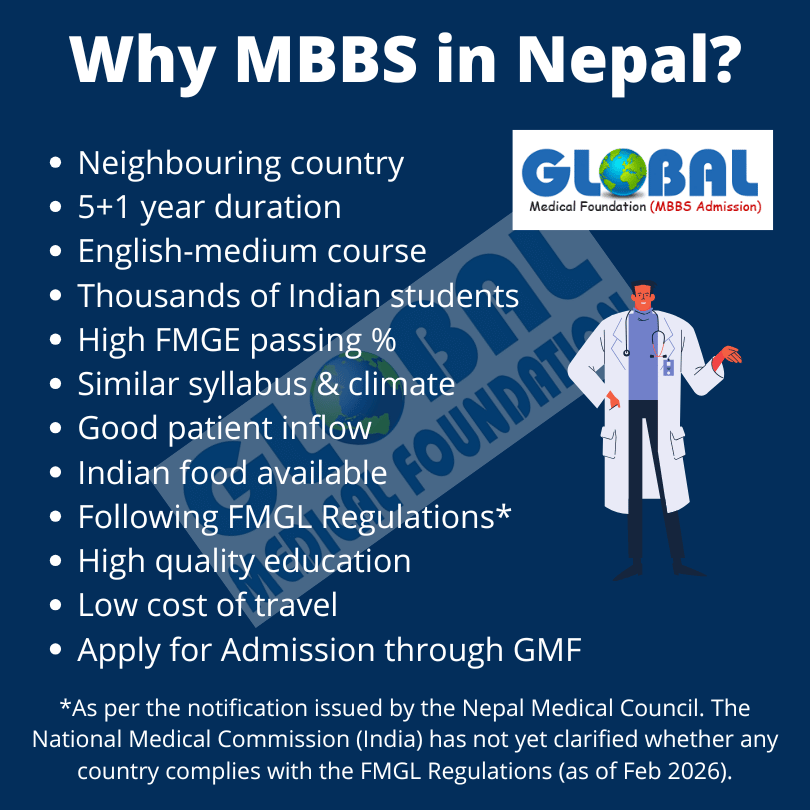
Indian students have long favoured studying MBBS in Nepal for its numerous advantages. It is a neighbouring country of India, making travel easy and cheap. There are several similarities in study patterns, and the disease patterns are also similar. Nepal is also among the very few countries that appear to comply with NMC’s Foreign Medical Graduate Licentiate Regulations (as per the notification by Nepal Medical Council).
Nepal’s course structure, duration and MBBS syllabus are similar to those of India. That is the main reason the FMGE pass rate for students returning to India from Nepal is high. An updated, modern education system with a similar curriculum and strong exposure to practical training gives a clear edge to fresh pass-outs over other-country read-and-study pass-outs. Nepal is among the top 10 destinations for Indian students seeking an MBBS abroad.
Indian students have been graduating from various medical colleges in Nepal for many years, and almost every college has a significant number of Indian students. In terms of FMGE pass rates, graduates from Nepal usually fare better than those from countries such as Kyrgyzstan, Kazakhstan, and Russia. However, any high-quality product commands a premium price.
The only factor holding many students back from applying in Nepal is the MBBS fee structure. Most of the universities charge around ₹50-75 lakh for the MBBS course, and you are required to pay 40-50% of the total fee in the first year itself. The high cost of education makes studying for an MBBS in Nepal unaffordable for many students. If you are looking for options in a budget of ₹25-35 lakh, which includes tuition fee, hostel fee and food expenses, then you can check the following countries:
On this page, you will learn about the following:
Table of Contents
MBBS in Nepal for Indian Students
MBBS from Nepal for Indian students overview –
| MBBS Course Duration | 4.5 years + 1-year internship in Nepal |
| Medium of Instruction | English for the full course |
| Do I need to learn the local language? | Yes, you will have to learn Nepali. |
| Weather conditions | The weather is favourable, and it is a significant advantage for Indian students. |
| WHO-approved universities | Yes |
| Types of Universities | Both Government and Private |
| Fee structure | ₹50-70 lakh on average. Approximately 40-50% of the fee is payable in the 1st year. |
| Entrance exam? | The student may be required to take an entrance exam. All students have to go through the counselling process. |
| Dominant Religion | Hinduism is the dominant religion in Nepal (81.34% of the population). Next comes Buddhism with 9% and Islam with 4.4%, |
| MBBS in Nepal valid in India? | Please check the Foreign Medical Graduate Licentiate Regulations. |
| Do I need to qualify NEET to study MBBS in Nepal? | Yes, qualifying NEET exam is mandatory for admission. |
| Top University | There are many top colleges in Nepal. Contact GMF for personalised counselling. |
Does MBBS in Nepal fulfil FMGL Regulations?
The FMGL Regulations, or Foreign Medical Graduate Licentiate Regulations, were introduced by the NMC in November 2021. Any Indian passport holder who wishes to pursue an MBBS abroad and wants to appear for the licensing exam (FMGE) in India must fulfil all requirements under the FMGL Regulations.
Since its introduction, NMC has provided no clarity on which countries’ MBBS programs comply with the FMGL Regulations. Therefore, there is no way to guarantee that any country, including Nepal, meets all the conditions under the FMGL Regulations, as NMC has not yet issued any guidance and is the only institution authorised to make this determination.
However, the Nepal Medical Council has posted the following notification on its website:
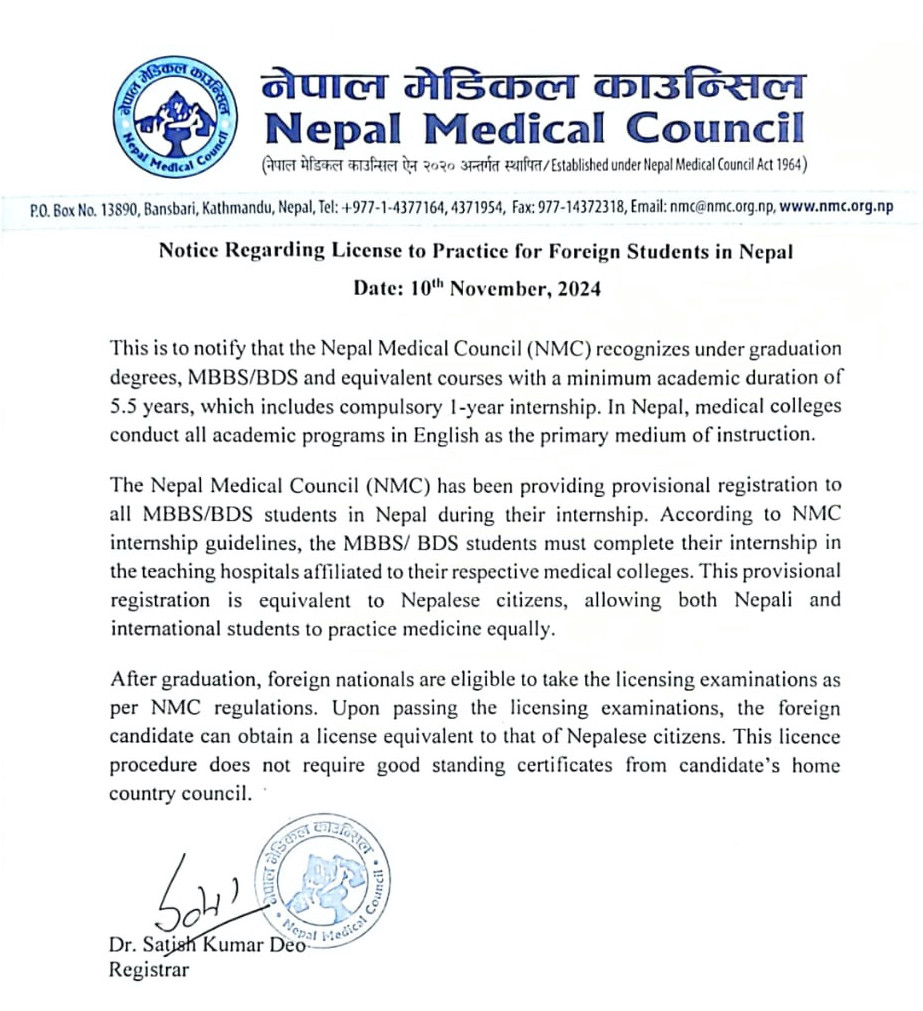
According to a notification from the Nepal Medical Council, the medical degree from Nepal meets most requirements under the FMGL Regulations:
| Requirement | Nepal Notice | FMGL Requirement | Status |
|---|---|---|---|
| 5.5 Year Course | Yes | Minimum 54 months + internship | ✅ Meets |
| 1-Year Internship | Yes | Mandatory | ✅ Meets |
| English Medium | Yes | Required | ✅ Meets |
| Equal License for Foreigners | Yes (clearly stated) | Mandatory | ✅ Meets |
| Registration Eligibility | Yes | Mandatory | ✅ Meets |
The medical degree of Nepal fulfils the above mentioned FMGL Regulations.
MBBS in Nepal Duration
According to a notification from the Nepal Medical Council, the MBBS program in Nepal lasts 5.5 years. The total duration of MBBS in Nepal is the same as in India. The duration is 4.5 years with 1 year of internship. After completing your MBBS in Nepal, you must clear the licensing exam (FMGE) to practice in India. Once you clear the screening test, you will be required to complete a 1-year internship in India. After this, you will get a permanent license number to practice as a doctor in India.
MBBS in Nepal Eligibility
Getting into a good MBBS college in Nepal is not as difficult or time-consuming as some might think. There are specific requirements and guidelines that a student must follow to secure a seat. To make things simple, call Global Medical Foundation, and we will help you get your seat in Nepal.
Let us see what the MBBS from Nepal eligibility criteria-
| Entrance Exam in India | There are no entrance examinations in India, such as IELTS/SAT. NEET qualification is a must for Indian students. |
| Age | The student must be at least 17 years old as of 31st December of the year in which admission is sought. |
| Board | The candidate must have completed class 12 from a recognised board. |
| Marks for General Category students | The student must have an aggregate of at least 50% in Physics, Chemistry, and Biology, and English must be a compulsory subject. |
| Marks for Other Category students | The candidate must have an aggregate of at least 40% in Physics, Chemistry, and Biology, and English must be a compulsory subject. |
| NEET | You need to secure the qualifying marks in NEET. The NEET result is valid for 3 years for MBBS abroad. |
| Entrance Test | Admission is based on NEET score or an Entrance exam. |
Documents Required for Admission in Nepal
The important documents needed for admission to MBBS from Nepal are –
- The student should have his/her 10th as well as 12th standard Mark sheet or Certificate
- Birth Certificate of the student
- Nationality or Aadhaar Card for identification
- Passport-sized photographs
- International students require a passport
- Valid NEET scorecard
MBBS in Nepal Fee Structure
As a neighbouring country, there is no need for an official visa, and accommodations and food are well-known, easy to obtain, and inexpensive. However, for some students, the MBBS fees in Nepal can be prohibitive and out of reach. The biggest barrier to MBBS admission in Nepal is the high fees that universities charge.
But we are here to help all families, assisting in finding what is best for their students. Below, we have listed every university with the fees charged. Here is the MBBS in Nepal fees structure:
University MBBS in Nepal Fees (Approx.)
B.P. Koirala Institute of Health Sciences ₹56.50 lakh
Nobel Medical College ₹65 lakh
National Medical College ₹55.50 lakh
Nepal Medical College ₹59.50 lakh
B & C Medical College ₹57 lakh
Kathmandu Medical College ₹65 lakh
Advantages of studying MBBS in Nepal
Here are some of the advantages of studying MBBS in Nepal as an Indian student:
- High-quality education.
- Low cost of travel.
- Similar curriculum to that of India.
- The benefit of being neighbours with our country: easy, hassle-free travel.
- High FMGE pass rate across many colleges. This shows that the quality of education is indeed good.
- The cost of living is much lower than in established countries for MBBS, such as the US, the UK, or Australia.
- Established MBBS abroad destination with a good number of Indian students in almost every college.
- The climate is similar to that of India, so the disease pattern is similar.
- Fewer language barriers.
College wise FMGE passing percentage
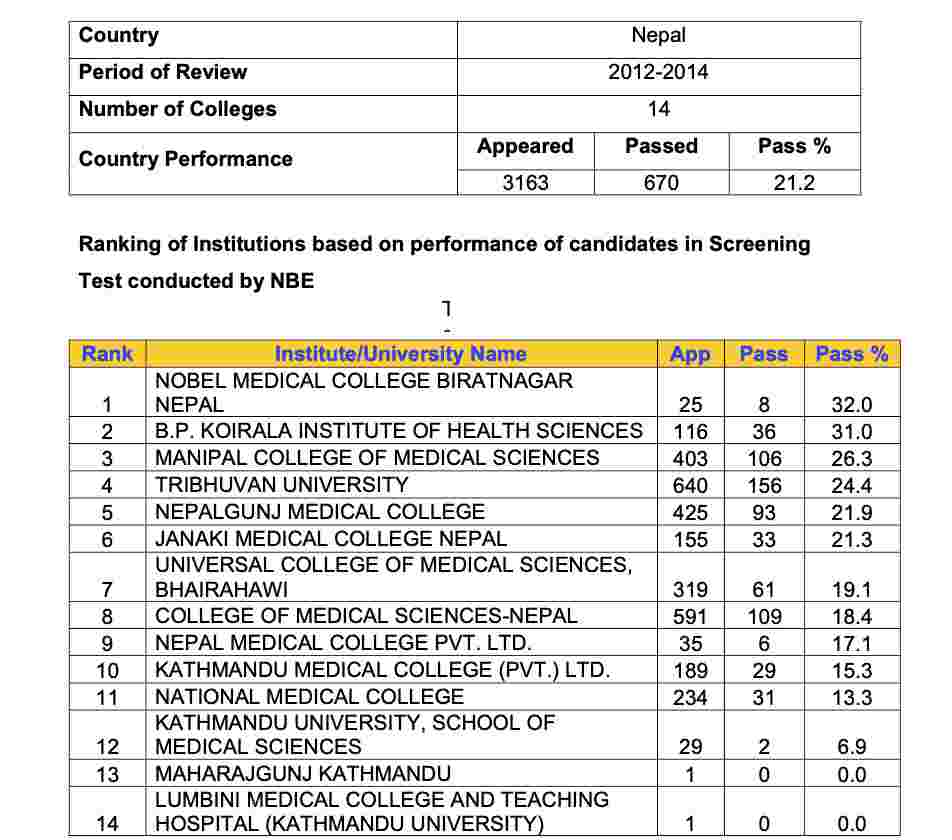
No matter where you study MBBS, ultimately, what matters is that you clear the screening test. Therefore, it is important to identify the universities from which Indian students have performed well. This information is provided to us by the National Board of Examinations (NBE), India. This is the body that conducts the screening test, the FMGE.
Here is the FMGE or MCI Screening Test passing percentage after MBBS in Nepal between 2012-2014:
Here is the FMGE or MCI Screening Test passing percentage after MBBS in Nepal between 2015-2018:
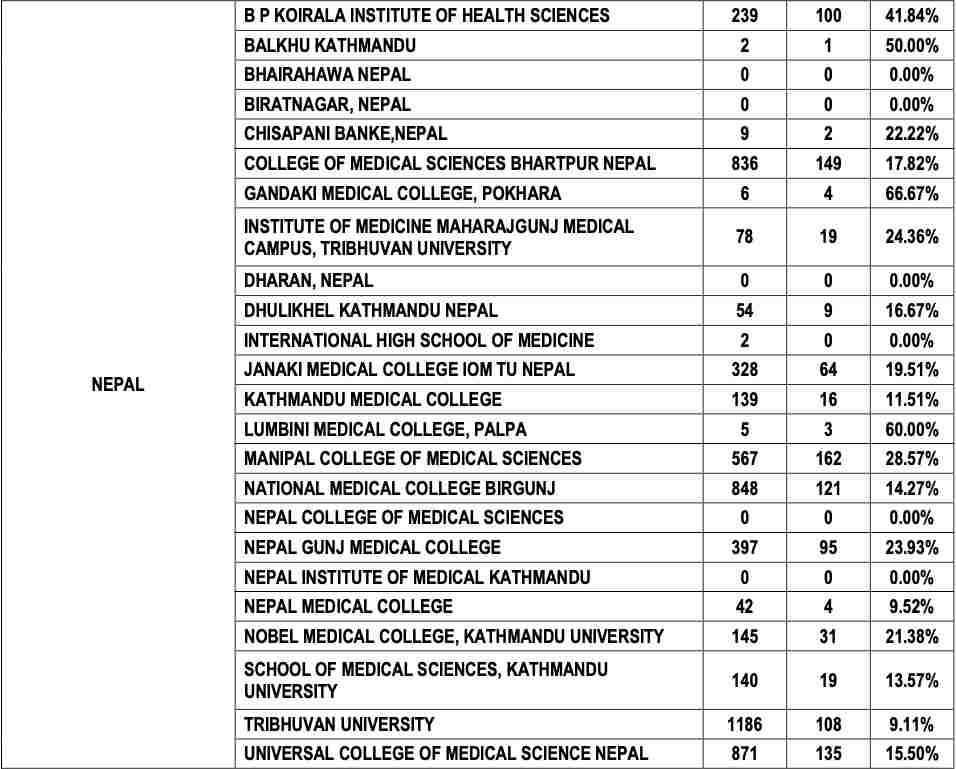
Check university and country-wise FMGE passing percentage from 2019 onwards –
What after MBBS in Nepal?
Here are the most common career paths chosen by Indian students after completing MBBS in Nepal:
Option 1: The most popular option is to return to India and apply for the FMGE. Prepare for this exam, clear it, and obtain your NMC registration number to practice medicine in India.
Option 2: While studying, you can apply for the USMLE in case you want to settle down or practice in the United States. The USMLE has 3 steps, and those who clear all 3 and obtain Permanent Registration from the medical council of the USA can practice there. PLAB, the UK’s licensing exam, is another popular choice for students. Students can also pursue a PG in Australia, Canada, New Zealand, or other countries.