Table of Contents
- BAU International University Batumi – Overview
- Why BAU International University Batumi?
- Quick facts about BAU International University Batumi
- Curriculum design of BAU International University Batumi
- Early clinical exposure at BAU International University, Batumi
- Simulation and Skills Labs of BAU International University Batumi
- Clinical Rotations at BAU International University Batumi
- Teaching Methods at BAU International University Batumi
- Assessment
- Research and Thesis
- Communication and languages
- Graduate Competencies
- Year-by-year snapshot
- Portfolio and Mentoring
- Facilities at BAU International University Batumi
- BAU International University Batumi Fees
- BAU International University Batumi FMGE Pass Percentage
- Who this suits
BAU International University Batumi – Overview
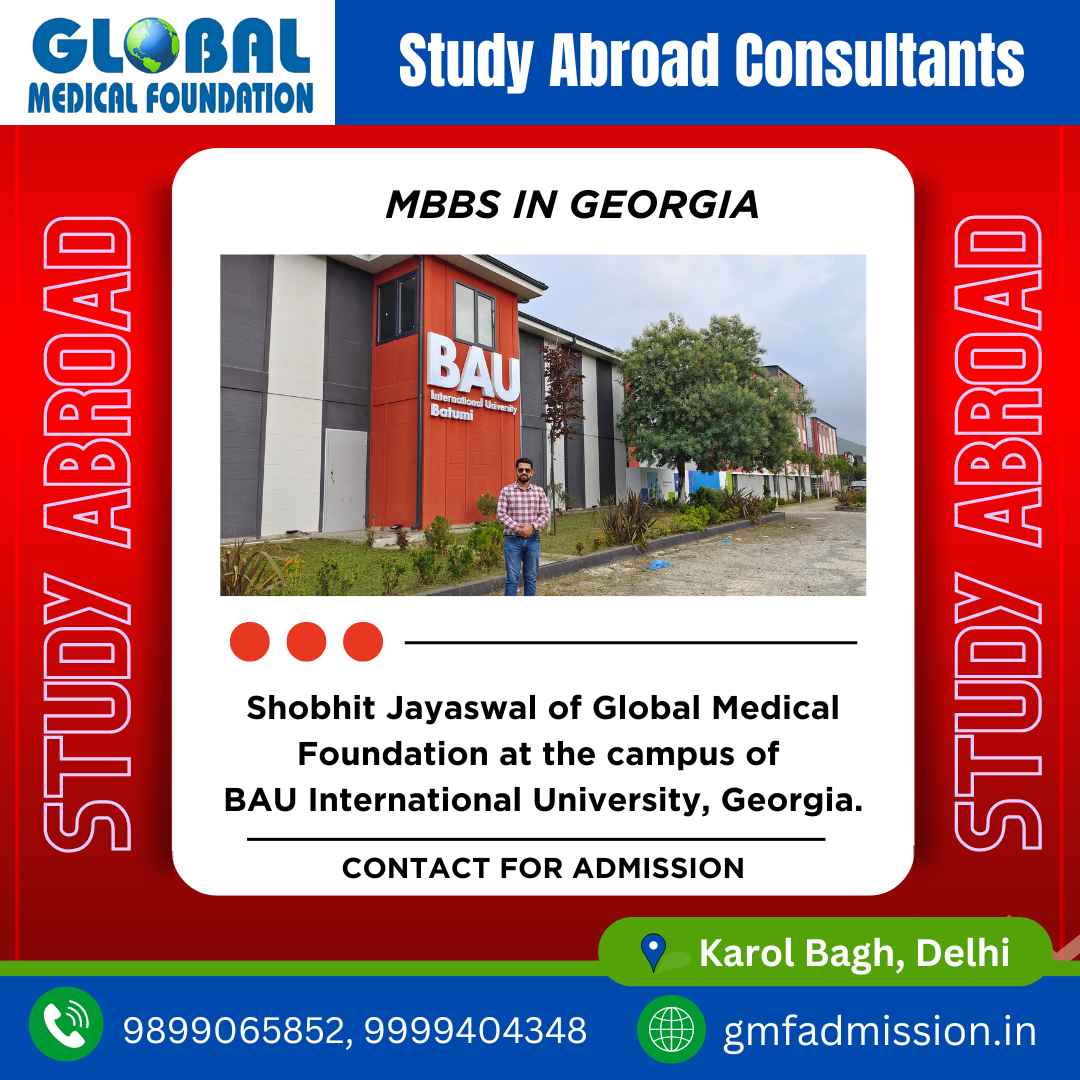
BAU International University in Batumi, Georgia, was established in 2015. It is a private medical university located in the beautiful city of Bautmi. BAU International University Batumi offers a 6-year, English-medium MD program (equivalent to MBBS) designed in accordance with international standards and featuring early, continuous clinical immersion. The program totals 360 ECTS (10,800 academic hours) and integrates biomedical sciences with clinical training from the first semester through to a practice‑intensive final year. Shobhit Jayaswal of Global Medical Foundation has visited the BAU International University, and we have sent many students to study MBBS at BAU International University in Georgia. It is one of the most affordable universities for MBBS in Georgia for Indian students.
The tuition fee for BAU International University Batumi’s 6-year MBBS course is approximately USD 4,800/year (approximately ₹4.20 lakh/year). In FMGE 2024, a total of 158 Indian graduates of Batumi International University appeared. Out of these 158 students, 100 successfully cleared the FMGE exam. This means that the FMGE passing ratio of the Indian graduates of BAU International University, Batumi, was an astonishing 63.29%. It was one of the highest FMGE passing ratios in 2024. To highlight the significance of this achievement, there were no universities in Russia, Kyrgyzstan, Kazakhstan, or Uzbekistan that had a higher FMGE passing ratio (with a minimum of 100 students who appeared in the FMGE).
Why BAU International University Batumi?
The curriculum aligns with the World Federation for Medical Education’s 2020 Global Standards and 2021 guidance on distance/distributed learning, adapted to Georgia’s national framework and the GMC learning outcomes. Teaching emphasises clinical thinking, communication, ethics, and evidence‑based practice, preparing graduates as compassionate team leaders and effective collaborators.
BAU International University, Batumi, had one of the highest FMGE passing ratios in 2024. To highlight the significance of this achievement, there were no universities in Russia, Kyrgyzstan, Kazakhstan, or Uzbekistan that had a higher FMGE passing ratio (with a minimum of 100 students who appeared in the FMGE).
Another big reason for Indian students to choose BAU International University is that it is located in Batumi, which has a similar climate to India.
Here is the average monthly temperature of Batumi:
| Month | High | Average | Low |
|---|---|---|---|
| Jan | 10°C | 7°C | 5°C |
| Feb | 10°C | 7°C | 4°C |
| Mar | 13°C | 9°C | 6°C |
| Apr | 16°C | 13°C | 9°C |
| May | 20°C | 17°C | 13°C |
| Jun | 24°C | 21°C | 17°C |
| Jul | 26°C | 23°C | 20°C |
| Aug | 27°C | 24°C | 20°C |
| Sep | 24°C | 20°C | 17°C |
| Oct | 20°C | 17°C | 13°C |
| Nov | 16°C | 12°C | 9°C |
| Dec | 12°C | 9°C | 6°C |
Quick facts about BAU International University Batumi
-
Degree: Medical Doctor (MD) | Language: English | Duration: 6 academic years.
-
Credit load: 360 ECTS | Total hours: 10,800 | Average daily workload: 7–8 hours.
-
Contact hours: 6,099 (including clinical and simulation) | Independent work: 3,999 hours.
-
Simulation training: 381 hours | Clinical environment training: about 1,700 contact hours.
-
Authorisation (July 8, 2021) and accreditation (March 27, 2020) by Georgia’s national quality bodies are noted on the program page.
Curriculum design of BAU International University Batumi
Learning is organised in horizontally integrated, transdisciplinary modules that build from normal structure/function to pathology and clinical application, system by system. Vertical integration introduces clinical concepts and visits from the first year, linking classroom learning with early patient-centred exposure.
Early clinical exposure at BAU International University, Batumi
Students begin clinical visits in the first semester to observe, adapt to the care environment, and connect theory to practice under the supervision of experienced professionals. Clinical time increases year‑on‑year, culminating in a final year dominated by in‑clinic practice across core specialities.
Simulation and Skills Labs of BAU International University Batumi
From year one, practical skills are built in a high‑fidelity simulation ecosystem using anatomical models, mannequins, standardised patients, and OSCE stations. Simulation peaks in early semesters and remains through the sixth‑year emergency medicine course, ensuring a safe transition from lab to bedside.
Clinical Rotations at BAU International University Batumi
Most clinical courses run as rotations of 1–6 weeks, progressively expanding responsibilities from observation to supervised patient care. The sixth year is dedicated to consolidating clinical practice in emergency care, internal medicine, surgery, obstetrics and gynaecology, paediatrics, psychiatry, and family medicine.
Teaching Methods at BAU International University Batumi
The program blends lectures, seminars, presentations, PBL, and CBL to foster analytical reasoning, teamwork, and independent learning. Laboratory work, simulation-based training, and progressive clinical teaching create a consistent “learn‑practice‑apply” arc across all six years.
Assessment
Assessment combines weekly activities, midterms/block tests, and finals, using written/oral exams, OSCE/OSPE, Mini‑CEX, DOPS, and practical evaluations. Scoring follows a 100‑point scale with defined grade bands, with credit awarded from 51 points and subject‑specific competency thresholds.
Research and Thesis
Research competence is developed through academic writing, research methodology and biostatistics, epidemiology, and two scaffolded scientific projects. Students plan and conduct research, analyse results, and publicly present a thesis, embedding evidence‑based medicine into clinical decision‑making.
Communication and languages
Communication skills and medical ethics are taught from year one through role‑plays, case work, and structured clinical communication courses. International students studying Georgian (22 credits) can communicate with patients; Georgian students may opt for German, English, or Turkish to broaden their clinical communication abroad.
Graduate Competencies
Graduates demonstrate sound knowledge, from the molecular to the systems level, as well as clinical reasoning, emergency care skills, and safe procedural competence. They uphold ethics and professionalism, communicate effectively with patients and teams, use information technologies, and commit to lifelong learning and public health responsibilities.
Year-by-year snapshot
-
Years 1–2: Integrated systems (e.g., cardiovascular, musculoskeletal, GI, neuro, endocrine), ethics, communication, and foundational pathology/immunology with early clinical links.
-
Year 3: Good Medical Practice, research methods, epidemiology, and introductions to internal medicine, surgery, paediatrics, OB‑GYN, neurology, and public health.
-
Year 4: Core disciplines—Internal Medicine I, General Surgery I, Paediatrics I, OB‑GYN I, Patient History, Public Health—emphasising clinical reasoning at bedside.
-
Year 5: Broad clinical specialities including neurology, dermatology, ENT, radiology, infectious diseases, anesthesiology, ophthalmology, cardiology, endocrinology, and family medicine.
-
Year 6: Clinical internships across the major disciplines, plus Emergency Medicine and Scientific Projects I–II to consolidate practice and research.
Portfolio and Mentoring
Student growth is documented in a structured portfolio that covers extracurricular achievements, clinical case presentations, and self-assessment, accompanied by faculty feedback. This continuous, student-centred feedback loop supports professional identity formation, accountability, and individualised development plans.
Facilities at BAU International University Batumi
The campus features modern lecture halls, computer rooms, a library, and nine teaching labs, as well as a research lab, alongside a Clinical Skills and OSCE Centre and an anatomical carving lab. Partnerships with clinics support hands‑on learning, ensuring smooth progression from simulation to supervised patient care.
BAU International University Batumi Fees
| Program | Medicine (MD) |
|---|---|
| Tuition (per year) | 4,800 USD (scholarship applied) |
| Tuition (per semester) | 2,400 USD |
| Application fee | Not applicable |
| Administration fee | 200 USD (one-time) |
| Hostel + Mess | 3,000 USD per year (includes breakfast and lunch) |
| Estimated total — 1st year | 8,000 USD (Tuition 4,800 + Hostel & Mess 3,000 + Admin 200) |
| Estimated total — from 2nd year | 7,800 USD per year (Tuition 4,800 + Hostel & Mess 3,000) |
Other Expenses:
- Temporary Residence Card – USD 200 in 1st and 2nd year only.
- Document and processing fee payable in India.
- Consultancy and visa fee payable in India.
- Flight ticket cost.
BAU International University Batumi FMGE Pass Percentage
BAU International University Batumi recorded a high FMGE passing ratio in 2024, reflecting strong academic preparation and outcome-oriented training for Indian graduates. In FMGE 2024, 158 Indian graduates from BAU Batumi appeared, and 100 qualified, resulting in a 63.29% pass rate.
This performance showcases the university’s effective curriculum alignment with FMGE competencies and its consistent support for students throughout the program.
The strong pass rate indicates robust foundations in clinical subjects, problem-solving, and exam-focused revision, which are crucial for clearing the FMGE.
Consistently good outcomes signal quality teaching, clinical exposure, and mentoring, helping graduates transition smoothly toward licensing and internships in India.
Such results enhance institutional credibility and reassure prospective students about academic rigour and post-graduation prospects.
Who this suits
This pathway suits motivated learners seeking an English‑medium MD with early patient contact, strong simulation training, and sustained clinical immersion. It is ideal for those who value ethics, effective communication, research literacy, and teamwork as essential components of becoming a modern physician.